Usability Study: Interviews with our community

Interview

One of my projects for this year is to conduct Summon After-Implementation study.  Summon is our new web discovery layer which was implemented in May 2016.  This study involved interviewing our community namely: Faculty members, PhD and MSc students and PostDoc.  One of the main objectives of this interview exercise is to obtain information on how they are using Summon to search for electronic resources.  In addition to that, I asked for their recommendations on improving their search experience.

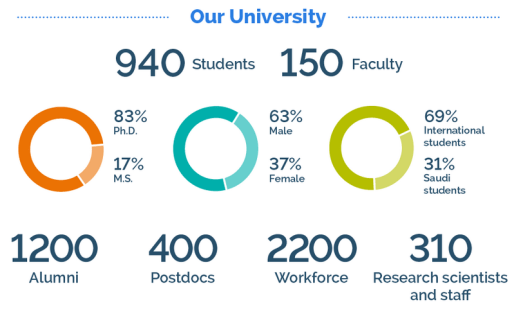
Quick Information about our International Graduate Research University:

KAUSTFact

Source:  https://www.kaust.edu.sa/en/about/media-relations#part3

Here are some quick takes:

  • Google Scholar is the go-to source for articles.  According to the participants, they obtain more relevant and faster (search return speed) hits compared to using Summon
  • Most of the participants searched for articles as compared to ebook / ebook chapters when using Summon
  • Use Summon to search for library’s print or electronic books collection.  An interesting comment: Google Scholar is not efficient enough to provide this information for them.  ** Imagine if Google Scholar is able to do this 🙂
  • Participants found that the search results in Summon are often too cluttered; giving rise to information overload.  Most of them are also unaware of the filter features that allow participants to filter out the ‘noise’ from their search results.
  • The search result return speed is another cause for concern (Summon).  Perhaps a more directed search approach would assist our users to get their information faster.  We could have tab / radio button options on our website to allow our users to search for articles; ebook / ebook chapters and print / AV materials separately.
  • Though some of the participants mentioned that they have attended our library training, there is not much evidence whether this has impacted their search experience in Summon.  (Another potential research topic 🙂 ).

Those are just some of the main points garnered from the interviews.  Any peeps out there willing to share their experience?

Resolving e-resources issues without loosing sleep …

  • Why am I not able to access and download this e-journal article?
  • I clicked on this link and all I got is a broken link?
  • Help!!! My IP address has been blocked … What do I do?
  • I’m traveling and I need access to this e-resource. How can I do it?Wire Googles Photo: Keyboard

These are just some of the questions that I get on e-resources issues.  Some are pretty straightforward but others require more time to resolve plus the involvement of various parties: publishers, vendors, and librarians.

Electronic resource management is a very fluid and dynamic area which involves peopleware, hardware, and software.  It is not just the flicker of the switch, turning the access on and the ‘story’ ends there.  More than often, maintenance and troubleshooting the e-resources issues comes into prominence.

What do you need to resolve these issues?

  • Good understanding of your ILS, discovery systems, AZ systems, link resolvers among others
  • Communication Skills – You’re gonna need it to understand the root causes, explaining this to the users/vendors/publishers/library community.  Following up and following thru; ensuring that all issues are tracked and there’s closure for all of them
  • Good system to track and monitor these issues (for example a ticketing system.  In our library, we used LibAnswers).

What are the main causes of electronic resources problems:

  • Broken Links to electronic journals, e-books / e-book chapters, e-resources websites
  • Excessive downloading
  • Wrongly-configured IP ranges / addresses
  • Off-campus access which usually involves proxy issues
  • Link resolvers
  • Subscription access: Publisher didn’t activate access to the correct subscription period
  • Change of publisher’s URL
  • Site maintenance
  • Internet Browser incompatibility
  • Link Resolvers not set up for Google Scholar

How do I and my team address them?

  • E-Resources triage:
    • Get the affected URL
    • Get the screen capture
    • Identify where the source of error / problem
    • Obtain information on:
      • IP address
      • Access location
      • Internet Browser
      • Internet Browser version
      • Operating System
  • Once the root cause(s) has been identified, our library staff will take the necessary follow-up action such as:
    • Amending data/information in Discovery layer, AZ system
    • Contacting the publisher(s) / vendor(s)
    • Contacting Uni IT

The story does not end there.  With the constant change in info technology field, (which inadvertently has an effect on electronic resources management), our ERM team need to be on our toes to keep abreast of such changes / advancements in order to resolve more challenging issues.

References:

Smith, K. (2016). Managing Electronic Resource Workflows Using Ticketing System Software. Serials Review, 42(1), 59-64. doi:10.1080/00987913.2015.1137674

Goldfinger, R. K., & Hemhauser, M. (2016). Looking for Trouble (Tickets): A Content Analysis of University of Maryland, College Park E-Resource Access Problem Reports. Serials Review, 00-00. doi:10.1080/00987913.2016.1179706

Samples, J., & Healy, C. (2015). Making it Look Easy: Maintaining the magic of access. Serials Review.


Managing user questions using cloud services: KAUST library experience

iMacMy paper for the previous Special Libraries Association / Arabian Gulf Chapter (SLA / AGC) 2017 has been uploaded to our university library’s repository.  Here’s the link to the full paper.  It (paper) outlined the tasks undertaken to implement our virtual reference tool (LibAnswers) as well as the challenges faced.

One of the benefits that we reaped after implementing this:

  • Eliminate chaos in tracking, replying and monitoring all questions coming via email / online forms
  • Better statistics management
  • Tagging feature
  • Public-Facing FAQ website for our users

Moving forward, we are taking a look at implementing the Ref Analytics feature.

Life as an E-Resources Librarian in an International Graduate Research University based in Saudi Arabia

Disclaimer: The following is my own personal account as a Singaporean Expat living in Saudi and may be different for others (usually based on their country’s passport *wink*).  I have been working in the library field for close to 20 years.

Before proceeding further, I’d like to thank my wife for sharing this journey with me and being my pillar of strength when the going gets tough.  Moving from a first world country,  you will need to have the crucial qualities such as patience, perseveranceresilience and a Can-Do / Never Say Die spirit.  Why those traits?  From my experience here, I’ve encountered many challenges and obstacles along the way that if you don’t possess at least one of those, you’ll probably just let everything go and leave.  You need to have an open mind.  Turn challenges into opportunities.  Like Denzel Washington said “Fall Forward“.  Understanding and respecting local cultures and communication norms would be very advantageous as well.

It began with Access and Digital Services Specialist which later turned out to be Electronic Resources Specialist.  The ride was initially bumpy filled with sweat, tears of joy/sadness against a backdrop of a dynamic work landscape.  Fast forward 7 years later, I won’t trade the valuable experience for anything less.  Life is full of tests and tribulations but in it, are lessons that money can’t buy.

I moved from Singapore to join a newly established Graduate Research university library based in the Kingdom of Saudi Arabia way back in late 2009.  I remembered the first time I stepped into the library; and bumped into the then library director, Joe Branin.  He was a warm, cordial and knowledgeable man; full of advice.  He made me feel at ‘home’ in my new surroundings. The very first Uni Librarian has since passed on. RIP Joe. You made every obstacle into an opportunity as reflected in the saying “What the caterpillar calls the end of the world, the master calls a butterfly.”   Richard Bach, (Illusions)

Being the Electronic Resources guy, I had the chance to work with various equipment: the main ones are: iMac, MacBook and my trusty iPhone – all provided by the university.  I ‘expanded’ that equipment to include IoS and Android devices.  Such is the support that I got over here.  One of the reasons why I got all those stuff is that I need to ensure that our e-resources work / behave well on all computers as well as mobile devices whether Windows, Mac, iOs and Android.  I get ‘fan-mail’ every once in a while when one of the e-resource titles don’t perform to expectation.

One of the things that you need to understand is to learn about the norms and work culture over here especially when locals are involved.  Working in a multi-cultural team is sometimes perplexing and needs adjustments at many levels in terms of expectations and understanding the knowledge and expertise of each team members.  Sometimes, a staff may be at a disadvantage due to his/her ‘indispensable’ status in a department especially  when he /she is so used to multi-tasking in their country of origin.

For example,  a staff who is good at his or her work may be held back in the trenches.  The Boss may feel that by having this individual around would be useful in getting the job done and done well where other staff fail(s) to deliver.  On top of that, the individual may be asked to ‘mentor’ other group members as they are not apt in their area of work.  This may be good for the Boss but not for that individual who will have to put in ‘double or triple shifts’.

Like most universities, this place is a flat organization.  Perhaps, any dissatisfaction with regards to promotions is quelled by trips abroad for conferences,  international paper presentations and of course not to mention the most important deciding factor is the remuneration perks.

To excel as an E-Resources Librarian, you need the key professional competencies as outlined by NASIG:

Life cycle of electronic resources:
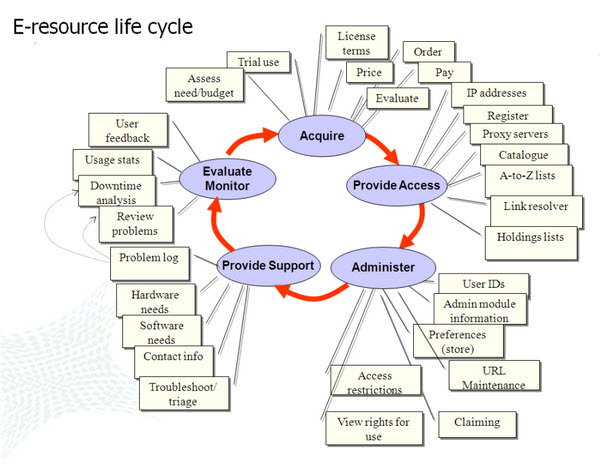
erm_pesch2009
(Pesch, 2009)

You need to have knowledge on this.  I picked it up on the go over here.  Because of my background in Reference work and Web usability, the learning curve was gradual. Being in the electronic resources field also meant that I need to keep abreast of any technology changes.  I also have to be alert and stay on top of things (work-wise) so that they don’t fall thru the cracks.  In terms of “sharpening the saw”, I was fortunate that the library is supportive in my trainings which included attending a number of overseas conference(s). On top of that, I immersed myself in the numerous literature available on the subject matter.  Till today, I am still learning and would continue to learn.  At times, you will need to learn, unlearn and relearn.  You have to be honest with yourself.  It’s OK to admit not knowing some stuff on electronic resources management.  Take steps to address this by attending webinars, asking peers, read some books on the subject matter and so forth.

Last but not least, you sincerely want to make the organization that you work in to be successful and not just mediocre when compared to international standards. To achieve this reality and not just a mere figment of our imagination, everybody’s efforts and contribution counts regardless whether they are locals or expats.  After all, most of us are motivated to work and aim to ensure that the workplace would be successful and stand shoulder to shoulder with our peer universities.  However, the practice of promoting duds; those who do not have the RELEVANT expertise or experience should be stopped as such negativity would only slow down or worse impede , the vision of any university and bring down the morale of those who are passionate and good in their work.