10 Time Management Tips for Busy Librarians

If there’s one thing I’ve learned over the years, it’s that librarians wear a lot of hats. From helping users with research to managing collections, attending meetings, and keeping up with new trends—there’s always something demanding your time. It can feel overwhelming, but the good news is that small changes can make a big difference. Here are 10 practical, tried-and-tested tips to help you manage your time better and, hopefully, find a little more balance along the way.


1. Prioritize with a To-Do List 📋

There’s nothing quite as satisfying as crossing items off a to-do list! Start your day by jotting down what needs to get done and focus on the most important and urgent tasks first. I also include a couple of easy-to-complete items—because, let’s face it, checking things off feels great and gives me the momentum to tackle the bigger stuff.


2. Time Block Your Calendar 🗓️

Instead of letting tasks bleed into one another, I block out time for specific activities on my calendar—an hour for emails, two hours for project work, or 15 minutes to grab a coffee. Time blocking helps me stay focused and prevents tasks from taking over my whole day.


3. Learn to Say “No” (Politely) 🙅‍♂️

Saying “yes” to every request is tempting, but sometimes you have to protect your time. I’ve found that politely saying no—with a little kindness—works wonders. Something like, “I’d love to help, but I need to focus on a priority task right now. Can we revisit this later?” sets boundaries without burning bridges.


4. Automate and Delegate When Possible 🤖

Over time, I’ve learned that I don’t need to do everything myself. Automating small, repetitive tasks (like sending reminders) saves time. Delegating tasks to team members also helps lighten the load—a great way to allow others to grow.


5. Use Focus Tools for Deep Work 🧘

We’ve all fallen into the trap of quick distractions (hello, endless emails!). Using tools like the Pomodoro Technique—where you work in bursts with short breaks—has helped me stay productive. Apps like Forest block distracting websites, keeping me focused when I need to dive deep into a task.


6. Make Meetings Short & Purposeful 🧑‍💼

Meetings can be helpful—but only when they’re managed well. I always ask: “Is this meeting really necessary, or could it be a quick chat or an email instead?” If a meeting is essential, I stick to a clear agenda and aim to finish early. It’s incredible how much more efficient meetings can be when everyone is on the same page.


7. Take Breaks to Recharge ☕

I used to power through long workdays, thinking it would help me accomplish more. Spoiler alert: it didn’t. Now, I make time for short breaks throughout the day—even if it’s just five minutes to stretch or sip coffee. Those small pauses help me recharge and come back more focused.


8. Reflect & Adjust Your Routine Regularly 🔄

No routine is perfect, and things change. I take time every week to reflect on what worked well and what didn’t. Did I manage my tasks effectively? Could I have scheduled things differently? This reflection helps me make small adjustments and keeps me on my game.


9. Leverage Apps Like Trello & Outlook 📱

Keeping track of tasks and schedules can be overwhelming, but tools like Trello and Evernote help me stay organized. I also rely on Outlook to block time on my calendar and manage meetings. The right apps can make life a lot easier—just find what works best for you and stick with it.


10. Celebrate Wins, No Matter How Small 🎉

Getting caught up in what’s next is easy, but taking time to celebrate small wins is important too. Whether it’s wrapping up a tricky project or helping a student with research, those little moments of success keep me motivated. Every achievement counts—big or small!


Final Thoughts

Managing your time as a librarian isn’t about cramming more into your day—it’s about finding balance and staying focused on what matters. The key is to be intentional with your time and kind to yourself when things don’t go as planned (because let’s face it, they won’t always).

So, what’s your secret to staying on top of everything? Share your tips in the comments—I’d love to learn from you too!

#LibraryLife #TimeManagement #WorkSmarterNotHarder

Webinar: Tips to enhance your researcher’s productivity

A library dean will discuss strategies for librarians to guide users to reliable scholarly content, followed by a ScienceDirect product manager who will highligh product innovations and time-saving tips.

Source: Webinar: March 4 | Tips to enhance your researcher’s productivity

See how easy it is to keep track of things

In my line of work, there are just too many things to keep track.  Among them are meetings, project datelines, notes, troubleshooting issues, expiration dates of e-resources, renewal dates, license agreements, metadata issues, access questions, ebook/e-journal requests,   … the list keeps going on.

How do I keep track of all these?  One of the first methods that I used was noting down in a little notebook followed by pasting 3M post-its on my table, computer screens, coffee mugs … and anything else that I can use to stick those post-its.  I would not say that writing down and post-its are not productive/efficient.  They do. But as the list keeps growing at an alarming rate, I realized that I needed something more dynamic and robust to keep track the various projects, tasks routines as well as other miscellaneous stuff.

I tried to use different notebooks for various projects, daily routines and the like but it would be too troublesome and I could build a big library keeping all those notebooks. (I’d rather keep one journal to note down the daily happenings in my life).  I needed something that could allow me to see everything on one page at a single glance.   That’s when I discovered the following 3 cloud services while trawling the internet for answers.

  • Evernote
    evernote

    How this tool has helped me:

    • Keep all my critical notes by different category.  I can easily organize all my notes under different headers.   For example, I could slot several notes on electronic resources such as important IP ranges, Proxy information, useful tips and so forth under Electronic Resources.
    • Organize all my ideas, thoughts and suggestions in a single place.  These items could be stuff to write about any potential conference(s), training topics, improving workflows/procedures or even paper for submission to journal(s).
    • Import any significant Outlook emails into Evernote for future references.  So instead of searching/browsing those emails in Outlook, I can extract them into Evernote and save them under different headings.
    • Keep interesting presentation slides and make side notes on them.
    • Clip interesting articles on the Internet and convert them into Evernote notes.  I can then read these articles at a later time.
    • More info can be found here.
  • Trello
    trello

    (I got to know this while on a study visit to Duke University. I met the Head of the Acquisitions team who showed me how easy it was to track their purchases using Trello).  How this tool has helped me:

    • Organize different tasks for separate projects under one roof.  I can create multiple ‘boards’ to store various functions.  I can then monitor the progress of each of these tasks.
    • Control tasks that I have delegated to other team members.  I can track and check if there is a backlog.
    • Attaching file from DropBox or other places to the task(s) that I have created.  In this way, I do not have to toggle the different apps while looking for some information.
    • Create checklists and due dates for various tasks.
    • Import Outlook emails and embed them into a task.
    • Check this site for a tour of Trello.
  • DropBox
    dropbox

    • Save my documents (pdf, ppt, doc, Xls and much more) in the cloud.  I can retrieve them later wherever I am (need Internet connection).
    • Save the space on my laptop/desktop
    • Access on different mobile devices.
    • Info on Dropbox.

What about you? What tool(s) work for you and what doesn’t?

Managing tasks with ‘disruptive’ technology

This may sound cliche: I am swamped with project work, routine tasks, meetings, supervision work…and the list goes on.  I have tried a number of methods: from pen and paper, MS Outlook folder and other productivity tools to help me keep track of stuff.  One such tool that has helped me so far is Trello.

There are a number of Trello features that contribute to this.  Here’s one of Trello’s feature: (Oh for those who would like to know more about Trello, here’s a link to guide you.)

Delegate a task via email and with the help of Trello, get it ‘pushed’ into your ToDo Board.

Here’s how my Trello board looks like:

trelloboards

Suppose if I need to email and delegate a task to another staff, I’ll open MS OutLook and begin writing the email.  Once completed, here’s what I do:

  1. Open my Trello ToDo board. Locate the Show Menu (somewhere near the top right of the screen) and click on it.
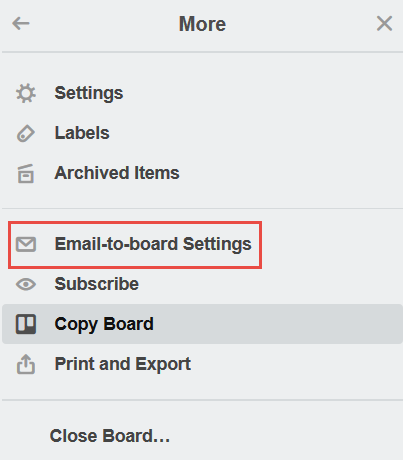
  2. Click More and “Email-to-board” settings.
    trellomore
  3. Ensure the Cards appear in the correct Column:
    trellocol
  4. Copy and paste the “Email Address for Board” into your BCC field of the email.
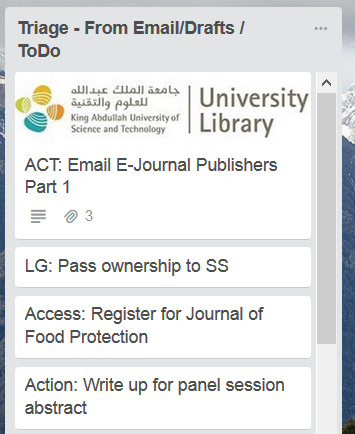
  5. If successfully executed, the email should appear under the correct column.
    trellotriage

Hope this simple stuff helps.

Useful Links: