Joys of being a Librarian in a newly established Graduate Research University (KAUST)

IMG_2575

  • Multinational, multicultural environment
  • Involved in various library initiatives / projects
  • Learning new resources and technology
  • Having a say in library policies
  • Opportunity to implement new methods / procedures
  • Imparting knowledge to newbies
  • Mentorship
  • Getting to know other cultures
  • Generous and kind hospitality of locals
  • Putting your skills to the test; stretching them at times
  • Satisfaction of helping people in obtaining the information that they need;
    seeing the smile on their faces
  • Demonstrating research methods to students and researchers
  • Attending overseas conferences / workshops, presenting papers and sharing of knowledge and ideas with fellow professionals
  • Publishing papers
  • Participate in community events such as “Parade of Nations”: Opportunity to see people dressed in their national costumes, taste ‘national food’
  • Perks

Waiting to Unleash the Beast – ‘Summon’ …

Focushttps://flic.kr/p/7VHwy6

Sharing my recent experience in leading a project team to implement our library’s new Webscale Discovery Layer (WSDL) – Summon.  For those who are not familiar with the term Webscale Discovery Layer, just imagine a search engine like Google that has the capability to search for all the library’s collection of electronic book/journal titles, e-book chapters, e-journal articles, printed titles, audio-visual titles and so forth.  Add in features such as filtering results, exporting to citation management software, emailing, printing the results and many more.  (Hope you get it …)

Part 1: Background Research

The journey towards Summon began when I was entrusted to study, explore and compare the then library’s Web Scale Discovery Layers – Innovative Encore (WSDL) against the other products available in the market.  The end-result of this study was a document that provided comparative information to the library management and IT & Systems team for next steps in evaluating and selecting the next web-scale discovery system for the KAUST library.

Some of my literature reviews:

  • Zhu, J., & Kelley, J. (2015). Collaborating to Reduce Content Gaps in Discovery: What Publishers, Discovery Service Providers, and Libraries Can Do to Close the Gaps. Science & Technology Libraries, 34(4), 315-328. doi:10.1080/0194262x.2015.1102677
  • Hanrath, S., & Kottman, M. (2015). Use and Usability of a Discovery Tool in an Academic Library. Journal of Web Librarianship, 9(1), 1-21. doi:10.1080/19322909.2014.983259
  • Deodato, J. (2015). Evaluating Web-Scale Discovery Services: A Step-by-Step Guide. Information Technology and Libraries, 34(2). doi:10.6017/ital.v34i2.5745
  • Silton, K. (2014). Assessment of Full-Text Linking in Summon: One Institution’s Approach. Journal of Electronic Resources Librarianship, 26(3), 163-169. doi:10.1080/1941126x.2014.936767
  • Pinkas, M. M., Baglivo, M. D., Klein, I. R., Brown, E., Harris, R., & Gerhart, B. (2014). Selecting and Implementing a Discovery Tool: The University of Maryland Health Sciences and Human Services Library Experience. Journal of Electronic Resources in Medical Libraries, 11(1), 1-12. doi:10.1080/15424065.2013.876574
  • Nichols, A., Billey, A., Spitzform, P., Stokes, A., & Tran, C. (2014). Kicking the Tires: A Usability Study of the Primo Discovery Tool. Journal of Web Librarianship, 8(2), 172-195. doi:10.1080/19322909.2014.903133
  • Collins, G., & Quan-Haase, A. (2014). Are Social Media Ubiquitous in Academic Libraries? A Longitudinal Study of Adoption and Usage Patterns. Journal of Web Librarianship, 8(1), 48-68. doi:10.1080/19322909.2014.873663
  • Chambers, S. (2014). Catalogue 2.0: Facet Publ.
    Cassidy, E. D., Jones, G., McMain, L., Shen, L., & Vieira, S. (2014). Student Searching with EBSCO Discovery: A Usability Study. Journal of Electronic Resources Librarianship, 26(1), 17-35. doi:10.1080/1941126x.2014.877331
    Bull, S., Craft, E., & Dodds, A. (2014). Evaluation of a Resource Discovery Service: FindIt@Bham. New Review of Academic Librarianship, 20(2), 137-166. doi:10.1080/13614533.2014.897238
  • Breeding, M. (2014). Chapter 3: References, Resources, and Appendixes. Library Technology Reports, 50(1), 53-58.
  • Breeding, M. (2014). Chapter 2: Major Discovery Product Profiles. Library Technology Reports, 50(1), 33-52.
  • Breeding, M. (2014). Chapter 1: Discovery Product Functionality. Library Technology Reports, 50(1), 5-32.
  • Way, D. (2013). The Impact of Web-scale Discovery on the Use of a Library Collection. Serials Review, 36(4), 214-220. doi:10.1080/00987913.2010.10765320
  • Foster, A. K., & MacDonald, J. B. (2013). A Tale of Two Discoveries: Comparing the Usability of Summon and EBSCO Discovery Service. Journal of Web Librarianship, 7(1), 1-19. doi:10.1080/19322909.2013.757936
  • Ellero, N. P. (2013). An Unexpected Discovery: One Library’s Experience With Web-Scale Discovery Service (WSDS) Evaluation and Assessment. Journal of Library Administration, 53(5-6), 323-343. doi:10.1080/01930826.2013.876824
  • Doğan, G., & Doğan, S. C. (2013). Evaluation of Web Discovery Services: Reflections from Turkey. Procedia – Social and Behavioral Sciences, 73(0), 444-450. doi:http://dx.doi.org/10.1016/j.sbspro.2013.02.074
  • Wilson, K. (2012). Introducing the Next Generation of Library Management Systems. Serials Review, 38(2), 110-123. doi:http://dx.doi.org/10.1016/j.serrev.2012.04.003
  • Moore, K. B., & Greene, C. (2012). Choosing Discovery: A Literature Review on the Selection and Evaluation of Discovery Layers. Journal of Web Librarianship, 6(3), 145-163. doi:10.1080/19322909.2012.689602
  • Moore, K. B., & Greene, C. (2012). The Search for a New OPAC: Selecting an Open Source Discovery Layer. Serials Review, 38(1), 24-30. doi:http://dx.doi.org/10.1016/j.serrev.2011.12.005
  • Little, G. (2012). Where Are You Going, Where Have You Been? The Evolution of the Academic Library Web Site. The Journal of Academic Librarianship, 38(2), 123-125. doi:http://dx.doi.org/10.1016/j.acalib.2012.02.005
  • Little, G. (2012). Thinking About Discovery Layers. The Journal of Academic Librarianship, 38(6), 346-347. doi:http://dx.doi.org/10.1016/j.acalib.2012.09.019
  • Kornblau, A. I., Strudwick, J., & Miller, W. (2012). How Web-Scale Discovery Changes the Conversation: The Questions Librarians Should Ask Themselves. College & Undergraduate Libraries, 19(2-4), 144-162. doi:10.1080/10691316.2012.693443
  • Johns-Smith, S. (2012). Evaluation and Implementation of a Discovery Tool. Kansas Library Association College and University Libraries Section Proceedings, 2(1), 17-23. doi:10.4148/culs.v2i0.1612
  • Jantz, R. C. (2012). Innovation in academic libraries: An analysis of university librarians’ perspectives. Library & Information Science Research, 34(1), 3-12. doi:http://dx.doi.org/10.1016/j.lisr.2011.07.008
  • Vaughan, J. (2011). Chapter 8: For More Information. Library Technology Reports, 47(1), 60-61.
  • Vaughan, J. (2011). Chapter 7: Questions to Consider. Library Technology Reports, 47(1), 54-59.
  • Vaughan, J. (2011). Chapter 6: Differentiators and A Final Note. Library Technology Reports, 47(1), 48-53.
  • Vaughan, J. (2011). Chapter 5: Ex Libris Primo Central. Library Technology Reports, 47(1), 39-47.
  • Vaughan, J. (2011). Chapter 4: Ebsco Discovery Services. Library Technology Reports, 47(1), 30-38.
  • Vaughan, J. (2011). Chapter 3: Serials Solutions Summon. Library Technology Reports, 47(1), 22-29.
  • Vaughan, J. (2011). Chapter 2: OCLC WorldCat Local. Library Technology Reports, 47(1), 12-21.
  • Vaughan, J. (2011). Chapter 1: Web Scale Discovery What and Why?</i&gt. Library Technology Reports, 47(1), 5-11.

I compared and contrasted the features of the various webscale discovery layers such as:

  • EDS: Ebsco Discovery Service
  • Encore Duet
  • Proquest Summon
  • OCLC Worldcat
  • AquaBrowser
  • Bibliocore
  • Encore
  • VuFind

Studyinghttps://flic.kr/p/mQYdec

Part 2: Compare and Contrast

From the products list, only 3 were selected for further review:

  • EDS Ebsco Discovery Service
  • Proquest Summon
  • Google Scholar (added to this list)

There were several main project tasks for this phase.  They included, among others:

  • Setting-up of trial websites for Summons & EDS
  • Delivering a Content Analysis Comparison Report
  • Online evaluation study – completed by library staff
  • Documentation based on the findings from the internal library staff.
  • Final Recommendation report

Our library staff evaluated the 3 products based on several criterion:

  • Navigation & Discovery
  • User Interaction
  • Content
  • Implementation

After reviewing and deliberating based on the evidences and data findings as well as the project team feedback, management decided to go for Summon based on:

  • ebook chapter searching capability
  • delivery features – linking to article(s)
  • database recommenders feature

In addition to that, we also decided to use 360 Link as our new link resolver.

Part 3: Implementation

One of the main aim of the implementation stage was improving access, organization, discovery and delivery of library’s acquired and subscribed resources (print, electronic etc) through the new web scale discovery service: Proquest Summon and Proquest 360 Link.  This was where the hard work began.  Tasks included:

  • Content Migration (All acquired and subscribed resources: print and electronic)
  • Uploading our research repository records into Summon
  • Scripts (Batch programs) for daily updates to Summon plus live updates as well
  • Widgets for Libguides, LibAnswers and relevant sites
  • Marketing materials: Summon giveaways
  • Branding / Logo that are consistent with our new library website

Next Steps

Work did not end even after the completion of implementation stage.  Things in the pipeline:

  • Marketing of new service
  • Liaising with Subject Specialist on instruction classes
  • Internal training for library staff
  • Monitoring Summon usage to get trends
  • Updating procedures and workflows including troubleshooting issues
  • Monitor impacts to Document Delivery services and Cataloging processes
  • Usability Studies

Project take-aways

I learned a lot from this experience.  There are sweet victories and there are also tough knocks.  They include:

  • Practice patience, perseverance and resilience
  • Every idea, feedback and comments matters: Nothing is too small to be ignored.
  • When you hit a brick wall, just find a way around it as long as it isn’t the Great Wall 🙂
  • Teamwork and more teamwork: Two or more heads are better than one
  • Learn, unlearn and re-learn: Learning is always a lifelong process
  • Adopt and adapt: Don’t be too rigid, learn to accept new ideas and even those that are quite radical 🙂


Relocation -to pack or not to pack

Flashback: 2009 (Before the move)

Preparing for the BIG move was quite a headache.  We are given  weight quotas for sea and air freight.  We had to decide the stuff that would be brought over from Singapore over to the Kingdom of Saudi Arabia.

I’m a sentimentalist; my other half more pragmatic.  In this situation, pragmatism won over the other one.  Only the ones that were needed most were shipped.  Before the packing day arrived, my wife had an idea to create a space where we would gather all the stuff for air / sea shipment.  This was done to reduce confusion.  The packers would just pack those in the ‘staging’ area.

So, the day finally came for the packing:

Shipment arrival in KAUST: 

Delivery day:  I requested the men to assist me in unloading and unpacking plus placing them in the rightful place: pots and pans in kitchen, clothes in the respective rooms and so forth.  I was thankful and grateful for all the prayer(s) and help for the smooth delivery of all our goods/stuff.  Wouldn’t have done it without my wife’s initial planning, coordination of the logistics departments in KAUST and the freight companies.


Out Fishing :)

Fishing@RedSea.  Tell you the truth, I never had any fishing experience. So you can imagine how fast my heart was beating when we headed out to sea, the Red Sea 🙂  My local friends taught me how to catch fishes using just a bait and a fishing line (without the rod).  They’re the experts and me, novice/amateur.  I didn’t manage to catch any but the other guys caught some while others caught seasickness (unfortunately).  At the end of the whole trip, my mother got wind of my ‘escapade’ and ‘ban’ me from ever going out for open-sea fishing.  Looks like I’ll be going to be pier / jetty if I ever wanted to do any fishing.

Doha Reloaded 2016 (Drinking water while diving, “Sambil menyelam minum air”)

Whirlwind business trip to Doha, Qatar. Attended workshop organized by LIAQ, (Library and Information Association, Qatar) on “Library trends: leading into the future” in collaboration with Mortenson center for international library programs.

Had a good discussion with Dr Clara Chu, Director and Distinguished Professor of the Mortenson Center.

Stayed at the Torch Doha. Wonderful place, plus it’s beside Villagio 🙂

The room is controlled by an ‘intelligent ipad’.  It controls all the room functions: from drawing curtains, the room lights, launching the internet, TV, movies, etc etc. Cool.

At the same, I visited my brother whose wife had just given birth: baby Boy.  (his third).  My parents were there too and I celebrated Mother’s day there as well.

Met up with an ol’ buddy.

IMG_3369

Airport scenes:

Tools of trade

Below is the list of tools (not exhaustive) which I find useful in my area of work.  (Not the ones in the illustration 🙂 )

Tools

My favs are Evernote, Trello and MS Sharepoint

Why Evernote? Helps me in keeping track of outstanding e-resources issues – I can attach information  to the notes in Evernote.  These also serves as a knowledge-base for me whenever I’m resolving similar e-resources issues.   Another feature that I find useful is collecting information from various sources such as internet, email snippets, etc.  On top of that, Evernote is also a tool that helps me collect and manage my information when I am planning for family activity such as vacations.  I’d plonked useful information into a notebook in Evernote for future references.

Trello is another tool: Simplifying project management.  I’m still learning this and it’s fun.  I ‘jot’ down all the tasks needed to be done for a particular project, tracking their progress, marking their completion dates and so forth.

MS Sharepoint:  I can create team worksites, document libraries, wiki and blog sites and even forum discussions.  I can share documents selectively, providing admin rights for certain staff and so forth.  There are loads of other features in Sharepoint.

What tools work for you? Appreciate your comments.

What does it take to work as E.R.S. over here …

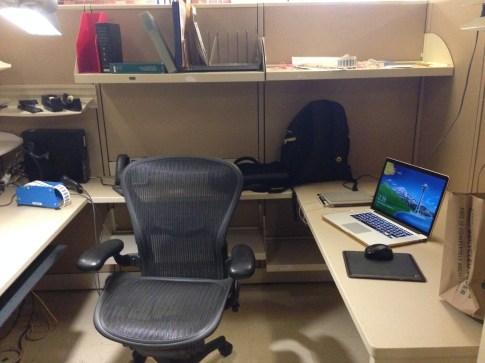
My office desk - May 2010This doesn’t look like my desk but I’m hoping to get 4 screens if possible 🙂
Source:  https://flic.kr/p/818pwN

ERS? It’s Electronic Resources Specialist. In some places, it’s also known as Electronic Resources Librarian etc.  My work deals mostly with electronic resources: electronic books, electronic journals, images and so forth.  I manage the life cycle from start to end; ensuring that trial, acquisition, access, troubleshooting and maintenance and renewal stages are completed.  I have a team of 4 (including myself).  It’s a thankless job at times; no thank you-s until someone cannot get access / download an article or chapter.

I’m not going to ramble on the competencies listed by several organizations such as NASIG (North American Serials Interest Group), UKSG (United Kingdom Serials Group) and the like.  Those are the intrinsic criterion needed.  I’ll list them down later in this blog post.  What I’m touching on are more on the ‘soft’ side of it.  For me, there are a few. They are:

  • Patience
  • Perseverance
  • Resilience

Quick check in Oxford Dictionary:

  • Patience:  “the ability to accept delay, trouble or suffering without becoming angry or upset”
  • Perseverance: “continue doing something in spite of difficulty or lack of success”
  • Resilience:  “able to withstand or recover quickly from difficult conditions”

In our work life, we have, in one way or another, face with testing situations.  In my case, it revolves around people or technology.  The technology part: that’s not that too difficult. Find the relevant manual, read it and you can get the answers.  Otherwise , you can contact the vendor techies and they are willing to check it out on your behalf.  Googling for answers would also be an alternative.

However, when dealing with humans, that can be tricky.  For example, not many would admit that they are wrong even when presented with facts.  The worst part is the “blame game”.  I believe that we can learn a lot when we readily admit our mistakes. Learn from it and move on.  Humans are never perfect.

point
Source:  https://flic.kr/p/7Fjpn

Coming back to the 3 traits, let me touch on the first one: Patience:  Leading requires patience. Mistakes happen; sometimes accidental; sometimes due to lack of knowledge.  Addressing those mistakes are important.  That’s where learning comes in: for both parties.  It provides a chance to address our shortcomings.  An opportunity for someone to learn new skills; an opportunity for someone to understand personality differences and how to navigate around it.  Win win scenario; hopefully.

The way we address these issues are also important.  Whether its one on one sessions or during team meetings, it will affect whether our message will get across.  Sometimes one to one meetings would work better than others.  In the context that I am in, I believe that having one to one ‘chats’ usually works.  Nobody likes to be mocked in public.

I do tolerate mistakes but if the same mistakes keep happening more than 2 times; that will set off alarm bells in my head 🙂  Either its a case of being incompetent or just insubordination.  Dealing with such cases require more tactfulness.

Perseverance. When the going gets tough, keep on moving, keep on striving.  For example, I encounter issues such as electronic resources sudden access disruption.  Now, the business work week in Saudi Arabia starts on Sunday till Thursday.  Imagine on a late Thursday afternoon, electronic publisher X (located in the States with business week starting from Mon – Fri) decided to pull the access plug for a particular product title ABC.  Reason: Detected excessive downloading activity.

I’ll be scrambling to get publisher X attention to inform them that we are on top of things and identifying the potential root cause.  Next, I have to make sure that our access is re-activated.  If I’m lucky, access is restored by Friday evening. Otherwise I would have to work during Friday (which is a weekend) by the way, to get it up.  If I miss it, then access would be affected till Monday afternoon when the publisher office starts work. (due to geographic time differences). Note that our work week starts on Sunday over here.

To complicate things, we may have researchers who are in need of access and who aren’t able to do so.  They may not know and do not want to know the reason why access is denied. What they want to know, when can they get access to the desired information.  In these instances, people management skills come in handy 😉

Resilience. Before taking my present job, I was previously a Reference/Subject Librarian and a Library webmaster.  Though electronic resources was not something new for me, I was faced with a steep learning curve.  I had to learn most of my stuff fast.  Sometimes you learn on the job.  On other occasion, you will rely on your intuitive and experience to get the task completed.  I had my ‘wins’ and my ‘losses’.  I faced setbacks.  Those setbacks provided a platform for me to learn and a reminder that my learning journey is never ending.

I had no mentor over here.  They expect me to hit the ground running.  Hence the expat terms 🙂  However, the support I got back then (and now) is enormous.  I’m grateful for that.  My superiors were ever willing to allow me to go for overseas conferences and trainings to complement my knowledge.

The adventure continues ….

Oh by the way, here’s the core competencies for Electronic Resources Librarian from NASIG.
 

Study Visit: Technical Services, Duke University Libraries (USA) 2015

I spent a week of ‘attachment’ with the Tech Services at Duke Uni Libraries (Oct 2015).  (Thanks to my superiors for their approval).  Met a lot of wonderful people.  Thank you Beverly, Jacqui and Will for your kind hospitality.  It was a pleasure getting to know all of you as well as the other library staff.  (just too many to recall their names).

Stayed at this neat hotel:

It used to be a hospital once. Historical Information about the hotel:

The hotel was a 10 minute walk to the Library Technical Services offices.

The Library Office’s name: Smith Warehouse.  It used to be a tobacco warehouse but converted into offices. (Pictures Below).

Whenever I have the time, especially in the morning, I’ll scoot off to get some food at the cafe:

OLYMPUS DIGITAL CAMERA

And best of all, they gave me a little office 🙂

IMG_1671

During my one week attachment, I had the chance to learn more about Duke Libraries’ Tech Services handling of their electronic resources.  It was an eye-opener for me.  They have a huge collection of electronic resources.  How they are handling this is amazing.

One of my areas of interest:  Troubleshooting electronic resources.  Asked a lot of questions on the common e-resources problems, how they ‘triage’ the issues, main root causes and how to resolve them.  I got to know the systems that they are using, the procedures and so forth.

All in all, it was a worthwhile trip.

** By the way, while exploring the bookstore downtown, I saw this on the shelves:

OLYMPUS DIGITAL CAMERA