2017 Highlights: Life as an Expat Librarian

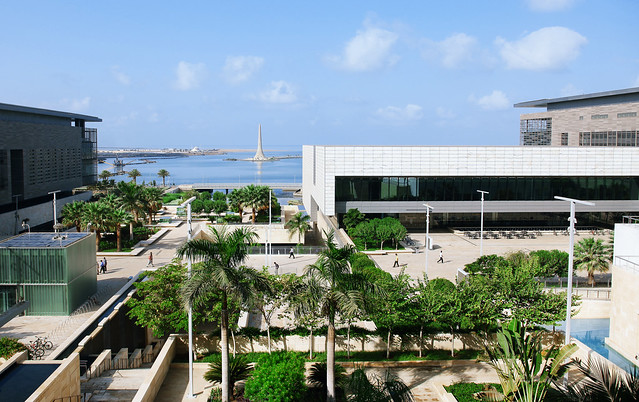
Alhamdulilah (Thank God). December 2017 marked 8 years of my stint in King Abdullah University of Science and Technology (KAUST).   Yes, it has been 8 years after I made that leap of faith – moving from Singapore to the Kingdom of Saudi Arabia.  During those 8 years, I’ve learnt a lot about expat life over here.  One of the things that really stands out is the kind hospitality and generosity of the locals.  This, I will never forget.  Thank you my friends – you know who you are.
img12

img19

Looking back: I’ve worked with and made a number of friends  from different countries; walk of life; varying degrees of work experience and different cultures. We’ve exchanged views, discussed, agreed to disagree; most of the time about work.  Coming from different work cultures and working style, we may have different way of executing tasks but in the end we always have a common goal – meeting our user demands and needs at the same time providing them with the best user experience (UX).

Highlights of 2017:

Alhamdulillah, I’d like to thank Dr Vijay (KAUST Library Director and Acting Manager) for allowing me to attend these conferences and trainings.  The experience had left an indelible mark on my career life.  Made new friends, discovered new information and shared know-how with peers.  I would also encourage my fellow librarians, if given a chance, to give conference presentations a go. Don’t miss it.

On top of that, I gained knowledge and friendship by participating in international library committees and library boards such as Electronic Resources and Libraies (ER&L),  ACM Library Advisory Board, IFLA Asia and Oceania Section as well as IGeLU Summon Product Working Group.

My gratititude also goes out to my parents, my family (esp my wife who has been my bedrock) and close friends.  Alhamdulillah.  Thank you for hearing my joys and pains.  I wouldn’t trade you for anything.

Looking forward to 2018: for new adventures, new discoveries, new inspirations. InshaAllah.

Never forget the 3 important keywords: Patience, Perseverance and Resilience.

2017 Reflections in Pictures:

And here’s to my library comrades:
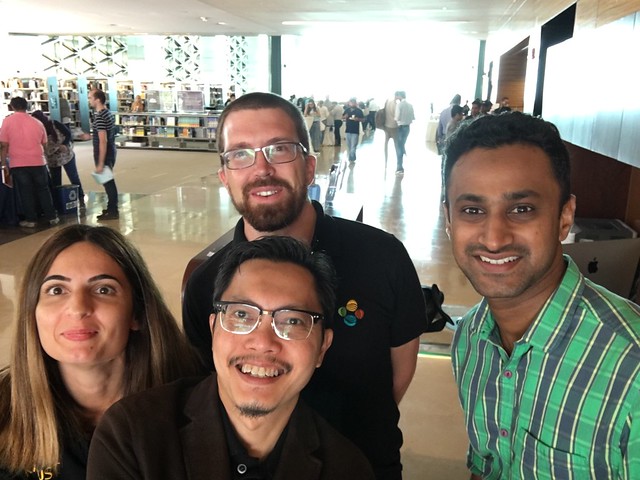
Library Day 2017

“Why academics and researchers still prefer Google Scholar?”

I was asked this question by someone. Here’s my personal take on this:

We cannot deny the pervasiveness of Google / Google Scholar usage among academics and researchers. One of the enticements of Google Scholar is the simplicity of the search box.  However, if we take a look at Discovery Products such as Summon, EDS, Primo and OCLC’s discovery layers, most of them are intertwined with the library homepages. Most if not all libraries infuse the discovery layer into their search box on their homepage. Compare our library’s Summon Start page: http://koral.summon.serialssolutions.com and our library homepage. Both are using the same Summon ‘search engine’ but different interface. How libraries design their website could have an impact on the use of these discovery layers. Another factor: How well are they marketing their ‘product’? This may sway their preferences of using Google Scholar than Discovery layers.

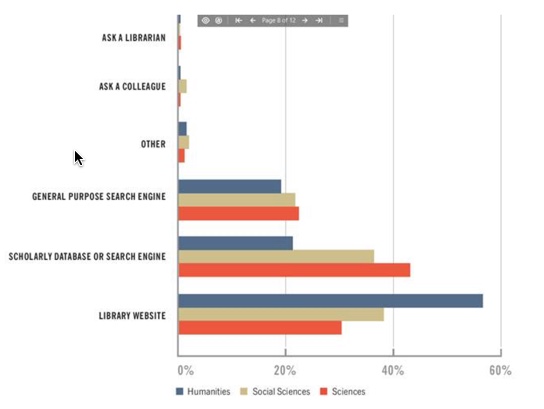
Coming back to the question: why academics and researchers still prefer Google Scholar? Are we referring this on a general basis or specifically our university academic and research community? Also, we need to categorize them (acad and research into the various subjects: Humanities, Social Sciences, and Sciences). There was a study by Ithaka that showed humanities group uses the library website more often compared to the Soc Sciences and Sciences. Turn the tables around, Humanities uses less search engine compared to soc sciences and sciences.

chart1

Source:  http://www.sr.ithaka.org/publications/us-library-survey-2016/

Based on my small focus group study on our university community, I noted that there was a mixture of feedback. Some were unaware of the search capability of KORAL (for example the search result facet etc). Some prefer to use to Google Scholar to search because its faster and many are accustomed to this. I had one who thought that KORAL only searches library information. It all depends on one’s preferences. When it’s ingrained in them, it will take an effort to make them move them out of their comfort zone.

Think about MP3 players. They do the same thing but Apple still has a big share.

I conclude that whether its discovery layer, Google Scholar or databases, libraries would need to cater to the various search nuances of our users. We can assist by providing complimentary tools to assist users in achieving their information need. At the end of the day, our users are mostly interested to get their hands on an article, ebook chapter, conference proc, books etc …. We can provide the various platforms.

To give another analogy: User need to get a choc bar at the grocery shop.  There are various options to get it: ask someone to buy for them;  go to the grocery shop either by taking a bus, walking or running or even cycling there and buy it.  The ultimate aim is to get that choc bar.  We cannot force them by using a certain pathway but we can provide them with viable alternatives.

Anyways here are some interesting articles:
http://crl.acrl.org/index.php/crl/article/view/16327/17773
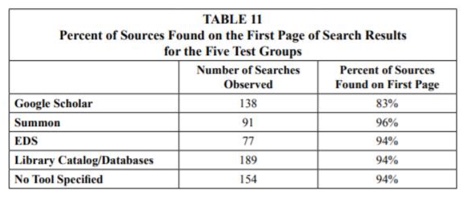
Paths of Discovery: Comparing the Search Effectiveness of EBSCO Discovery Service, Summon, Google Scholar, and Conventional Library Resources
Excerpt from article:

Table1

Source:  http://crl.acrl.org/index.php/crl/article/view/16327/17773

Check out this report by Ithaka: http://www.sr.ithaka.org/publications/us-library-survey-2016/
US Library Survey 2016 – There’s a section on discovery somewhere near the middle of the article.

“Library directors are increasingly recognizing that discovery does not and should not always happen in the library. Compared to the 2013 survey results, fewer library directors believe that it is important that the library is seen by its users as the first place that they go to discover content, and fewer believe that the library is always the best place for researchers at their institution to start their research. The share of respondents who agree that it is important that the library guide users to a preferred version of a given source continues to decrease.”

Another one: http://www.sr.ithaka.org/wp-content/mig/files/SR_Briefing_Discovery_20140924_0.pdf
Does Discovery Still Happen in the Library? – Ithaka S+R

Your thoughts?

IFLA World Library and Information Congress, Wroclaw Poland 2017 & ACM Library Advisory Board meeting

I had the opportunity to attend IFLA conference from 19 – 25 August 2017 in Wroclaw Poland.  (Thanks to my Boss, Dr Vijay, KAUST Lib Director for approving my trip).  The event was held @ Centennial Hall, Wroclaw. Before attending this conference, I also had the privelege to sit in the Association for Computing Machinery (ACM) Library Advisory Board meeting which was held @ SOFITEL WROCLAW OLD TOWN.

The opening session for IFLA was awesome.  The crowd was great.  The music, effects and performance were outstanding.  Forever etched in my mind.  Apart from that, there were several interesting presentations such as:

  •  Altmetrics: It’s Time to Take Action – Serials and Other Continuing Resources
  • Libraries: A Call to Action – IFLA President’s Session
  • IFLA Global Vision Discussion
  • Demonstrating the Contribution of Libraries to the UN 2030 Agenda

The poster sessions was good. There were numerous interesting posters that provided enlightening information from various libraries around the world:

Interesting sights of Wroclaw, Poland:

Visited  Wroclaw University of Science and Technology library.  Noted that the main library does not contain any print books.  Instead, they have lots of computers and discussion rooms for their academic community.  Most of their printed collections are kept in the Faculty libraries located in various buildings within the campus.  Another interesting fact: Games Room: where their students can play XBox 360.  I wanted to check it out but unfortunately the place was closed during the visit.


Hygge in the Library

I was introduced to a new word “hygge” via Blinklist today.  I wanted to discover more about hygge and started googling it as well as reading online articles about this new term.  What I got from Oxford online dictionary, the word ‘hygge’ means “A quality of coziness and comfortable conviviality that engenders a feeling of contentment or well-being (regarded as a defining characteristic of Danish culture)”  (URL:  https://en.oxforddictionaries.com/definition/hygge)

Several interesting articles on hygge:

At that moment, I wondered whether there are any Hygge spots in the library.  Places where our community can just unwind, huddle-up, or touch base with one another.

I ventured in the library locating every nook and cranny for Hygge spots – somewhere users can sit down and huddle, catch up or touch base with one another. Here are some of the spots that I got:

Not sure whether it’s correct to say this, but here goes: “Happy Hygge-ing” 🙂


Ramadan – Kaust 2017

Alhamdulillah, today mark the first day (27 May 2017) of the blessed month of Ramadan.  This is the month where Muslims all over the world observe ‘fasting’ or ‘sawm.’  Muslims abstain from eating and drinking from dawn till dusk.  Muslims also abstain from sexual activities.  “Those who are sick, elderly, or on a journey, and women who are pregnant or nursing are permitted to break the fast and make up an equal number of days later in the year.”  (http://www.islamicity.org/10254/about-fasting/, Accessed on 27 May 2017).  In addition to that, “avoiding immoral behavior (for example backbiting) and anger and showing compassion is part of the requirements of the fasting.”  (http://www.islamicity.org/10254/about-fasting/, Accessed on 27 May 2017).

Some useful sites on Ramadan:

Over here, there are some things to note:

  • Working hours are shortened for Muslim employees
  • Operating hours for shopping malls, banks, offices (some) and shops are changed; some would start around 2 pm; others would start around 5 pm.  All of them would be closed for prayer times, iftar (breaking of fast) and would open after isya and Taraweeh prayers ( around 1030pm) and would continue until the wee early morning hours (around 3 am) the next day.
  • Isya’ and Taraweeh prayers start 2 hours after the breaking fast.

Information about Ramadan is shared throughout our campus community.   For non-Muslim and first-timers experiencing Ramadan here, a number of talks, activities and information sessions are conducted to inform them about the meaning of Ramadan and what do Muslims do during this blessed month.  Community areas are open till early morning.  A whole range of activities is organized for the family and individuals living on campus.  Our community is also treated to a whole range of Ramadan treats and not forgetting the Arabic coffee.

We have spent close to 8 years over here.  There are many beautiful things that we have experienced during Ramadan.  The spirit of hospitality and generosity are prevalent.  During this time,  neighbors exchange food just before Iftar.  (Community spirit).  Being an international community,  we got to taste the different kind of food from all around the world.

It is also a time to increase our spiritual activities and to get closeness to God.  Our Grand Mosque on campus is always a hustle and bustle of activity during this month as congregational prayers plus the Qiyam (early morning prayers) are conducted.  Muslims would also spend time in the mosque reading the Holy Quran.  (especially during the last 10 days of Ramadan).  Muslims also visit the 2 holy cities of Makkah and Madinah during this time.

Even then, we still miss Ramadan back home in Singapore.  We miss going to the food bazaar to buy food for breaking fast,  miss breaking fast with family and Singaporean friends (though we occasionally meet with friends over here for Iftar) and the Taraweeh prayers at our local mosques (plus attending the nightly Ramadan sermons that constantly remind us of life as a true believer).

OLYMPUS DIGITAL CAMERA


Top 5 services deployed by Library Websites

From my comparative study on benchmarked library websites (2015) which was conducted together with my colleague, the Senior Subject Specialist, we noted that the top 5 services deployed the library websites were:

  1. User Services: Checking how items that have been borrowed, reserved status and so forth.
  2. Reference/Research Services: Asking a librarian question, live chat services.
  3. ILL/Document Delivery Request.
  4. New materials recommendations
  5. Library alerts, News, and Events.

chat

Top 3 Social Media tools deployed:

  1. Facebook
  2. Twitter
  3. Youtube

Digressing a bit: Social media is another avenue apart from the library websites where our users can also do stuff that is available on library websites.  We have already had library alerts and news announced on Facebook and Twitter.  We have seen library videos on how to borrow books in the library and so forth.  LibAnswers (online reference services) can be activated in Facebook and Twitter as well.  Users do not need to visit library websites anymore to get information.   On top of that, I had listened to a talk by one of the library directors that mentioned the low rates of library website visitations.

  • Should we worry that library websites are no longer the main source to get information?
  • How much of an impact have those services had on our users?
  • How do we measure the success rate of each visitation? How do we define success?

These are just some of the questions swirling in my head …

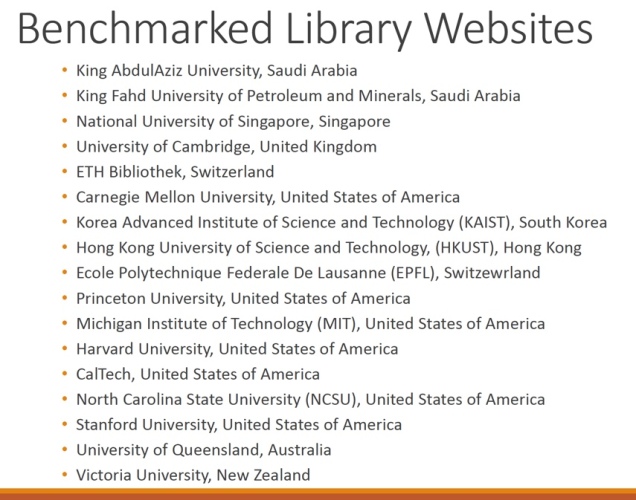
Below is the list of benchmarked library web sites that we had used:

library

ListBenchmarkedLibs

See how easy it is to keep track of things

In my line of work, there are just too many things to keep track.  Among them are meetings, project datelines, notes, troubleshooting issues, expiration dates of e-resources, renewal dates, license agreements, metadata issues, access questions, ebook/e-journal requests,   … the list keeps going on.

How do I keep track of all these?  One of the first methods that I used was noting down in a little notebook followed by pasting 3M post-its on my table, computer screens, coffee mugs … and anything else that I can use to stick those post-its.  I would not say that writing down and post-its are not productive/efficient.  They do. But as the list keeps growing at an alarming rate, I realized that I needed something more dynamic and robust to keep track the various projects, tasks routines as well as other miscellaneous stuff.

I tried to use different notebooks for various projects, daily routines and the like but it would be too troublesome and I could build a big library keeping all those notebooks. (I’d rather keep one journal to note down the daily happenings in my life).  I needed something that could allow me to see everything on one page at a single glance.   That’s when I discovered the following 3 cloud services while trawling the internet for answers.

  • Evernote
    evernote

    How this tool has helped me:

    • Keep all my critical notes by different category.  I can easily organize all my notes under different headers.   For example, I could slot several notes on electronic resources such as important IP ranges, Proxy information, useful tips and so forth under Electronic Resources.
    • Organize all my ideas, thoughts and suggestions in a single place.  These items could be stuff to write about any potential conference(s), training topics, improving workflows/procedures or even paper for submission to journal(s).
    • Import any significant Outlook emails into Evernote for future references.  So instead of searching/browsing those emails in Outlook, I can extract them into Evernote and save them under different headings.
    • Keep interesting presentation slides and make side notes on them.
    • Clip interesting articles on the Internet and convert them into Evernote notes.  I can then read these articles at a later time.
    • More info can be found here.
  • Trello
    trello

    (I got to know this while on a study visit to Duke University. I met the Head of the Acquisitions team who showed me how easy it was to track their purchases using Trello).  How this tool has helped me:

    • Organize different tasks for separate projects under one roof.  I can create multiple ‘boards’ to store various functions.  I can then monitor the progress of each of these tasks.
    • Control tasks that I have delegated to other team members.  I can track and check if there is a backlog.
    • Attaching file from DropBox or other places to the task(s) that I have created.  In this way, I do not have to toggle the different apps while looking for some information.
    • Create checklists and due dates for various tasks.
    • Import Outlook emails and embed them into a task.
    • Check this site for a tour of Trello.
  • DropBox
    dropbox

    • Save my documents (pdf, ppt, doc, Xls and much more) in the cloud.  I can retrieve them later wherever I am (need Internet connection).
    • Save the space on my laptop/desktop
    • Access on different mobile devices.
    • Info on Dropbox.

What about you? What tool(s) work for you and what doesn’t?

Growing banana without going “bananas.”

I’m not into Gardening that much.  About 3 years back, I grew a little banana plant in my backyard.  Tried to see how far it would go.  Did the usual stuff, watering and fertilizing the plant.  A few days back, I saw this:

Anyway, I did some research on the best time to pluck the banana from the tree.  Got to the following links.  Anybody out there has other information on this.  (Not the alternative facts please …)

I’m wondering when I should pluck those bananas. Won’t want to do it prematurely 🙂

From Millennium ERM to Proquest 360 Resource Manager: Our library’s Journey


I’ve just completed the slides for the Electronic Resources Management Systems ERMS project.  Highlighted the library’s journey to the new ERMS – Proquest 360 Resource Manager.  I recalled the 3 phases that the project went thru.  Each of them posed challenges and issues that the project team had to face head on.  Endured late but not sleepless nights.  Discussions, disagreements, and compromise.  Yes, it was hard work; at times it can be nerve-wracking but all in all, it was an enriching experience.

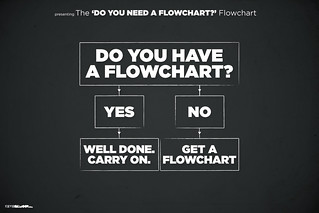
Do you have a Flowchart?

Lessons learned:

  • Awareness of the available ERMS in the open market. Products are constantly changing and companies merge. Staying on top of things are advantageous as the library can re-position itself in the case of any advancements/product / company mergers
  • Match the ERMS features against the team’s ERMS wish list. Before embarking on the ERMS project, conduct a study of the strengths and weaknesses of the present system. Identify what can be improved and what are the missing ‘pieces’ that should be evident in the new ERMS
  • Contact peers on their experience on using the ERMS products. Most if not all of
    E-Resources Librarians are willing to share information and knowledge. Compare notes. Sometimes, what works for them may NOT work for us.
  • Keep communication open. Ensure that library management and project team are updated on the project progress.
  • There may be hiccups/challenges along the way. Stay focus and keep calm.

Looking for more adventures on this road …..