My first 100 days and more

Here I am, back home, starting on my new position as the Assistant Director in the Advisory and Consultancy team of NTU Library. It is very different from my previous job. More challenging, constant learning and I would say more project management stuff. I am enjoying my new stint and looking forward to the challenges thrust on me.

The team
I work with a dynamic team comprising of young and several senior library staff — a good mixture of experienced and go-getters. Each one of them has a diverse background; some have been at this place for years while others are starting on their career. Here’s a brief write-up of the team and what we do: https://blogs.ntu.edu.sg/ntulibrary/2018/10/29/introduction-of-advisory-and-consultation/

What I do
One of my key responsibilities now is the provision of leadership in the area of advisory, consultation, and professional information services to students and staff in the College of Humanities, Arts, and Social Sciences specifically. However, this is not limited to just that as I am also involved in supporting the learning, teaching and research needs of the to the entire university community.

Some of my work now focuses on the delivery of specialized services for our academic community: faculty members, undergrad and postgrad students, and researchers. These activities include one-on-one consultations, customized workshops as well as orientations for our new staff. I forge close relationships with faculty members especially the new ones. During the orientation sessions for the faculty members and researchers, our team disseminates information on the library’s services that support research such as data management planning, publishing scholarly materials and communicating research work(s); to name a few.

Apart from that, I also respond to the inquiries that come in via email, in-person, social media as well as the phone. Email is the most common conduit in receiving questions which may vary from simple to complex ones.

Ensuring that our academic community has access to the various resources is also an essential part of my work. Close collaboration with other library teams, vendors and publishers are necessary; more so as most of our resources are in electronic and digital format. Constant communication and meetings are a must as everyone needs to be on the same page.

Managing users’ expectations is crucial. Some requests can be urgent while others are not. Users don’t like to be kept in the dark. Thus, you need to make them understand that their needs are not forgotten. Keep them in the loop of things. Out of all this, you can have a sense of what are the primary needs and what are the pain points faced by the academic community.

Lessons Learn so far

  • Listen more, talk less; Keep a look-out for new trends
  • An open mind
  • Patience and Persevere

Moving forward

  • Intend to get my hands dirty with User Experience / Usability Studies stuff.
  • Explore new niche areas in the field of library services.

Stay tuned.

Journey diverted and a New Adventure begins

road

It’s been a busy 2018.  To summarize, I have made the decision to move back to Singapore after spending close to 9 years plying my trade in a Graduate Research Library in the Middle East.  It had been an eventful ‘ride’.  I have never regretted making the move to work in the Middle East.  I will always treasure the friendships I’ve made, fun and laughter, sweat and tears during those 9 eventful years.  I’ve learnt a lot.  It has truly  been an eye-opener.  Thank you all: friends, colleagues and acquaintances.


Electronic Resource Management: Handling users’ pain points

monitor


I missed this year’s ER&L 2018 conference.  It has always been one of my favourite conferences and it never fails to amaze me with an interesting line-up of insightful presentations and workshops.  While checking out the tweets for this year’s conference, I came across this wonderful article by Claire O’Neill, Library Services, Wiley, on the top 10 trends@the conference.

Top 10 Trends at the 2018 Electronic Resources & Libraries (ER&L) Conference | Wiley

I love the following points brought up by the author:

4.  Thinking outside of the box to identify student pain points

5.  Getting creative with outreach

6. Librarians work hard – and deserve acknowledgement

9.  Librarians share tips for improving user experience

10.  Information is power

Point 4 stood out for me.  Why?  Working in the electronic resources management field, I have always received a number of fan-mails from our users on electronic resources issues.  Their questions range from simple ones such as creating a personalized account in a particular electronic resources publisher website to more complex access issues such as accessing our subscribed e-resources off-campus.  As I received more and more of such questions, several thoughts flashed across my mind:

  • How can we alleviate the “sufferings” faced by our users proactively?
  • Can we better manage these issues by providing information up-front to them so that they are able to resolve these issues by themselves?
  • How can we heigthen the awareness of our users that such information are available?
  • How can we cull such questions and study the trends/patterns?
  • Are there any system that can manage these inquiries and provide meaningful data for us to analyze?
  • What can the library do to upkeep and update the staff knowledge on ERM matters?
  • … (the list goes on)

So many things, so little time on top of the limited resources. What are the ones that should take priority over others?  It reminded me of my first day in the office when I set out to become an E-Resources Librarian/Specialist (most of use are called Specialists over here).  It dawned upon me that among my main focus would be the troubleshooting of electronic resources and managing our users’ expectations.  Users always wanted information fast and within a few clicks.  They can get pretty irate and frustrated whenever their search hits a brick wall. (paywall seems much appropriate 🙂 )  How can our ERM team ensure that this does not happen? How can we manage our users’ expectations with regards to the workings of our subscribed electronic resources.

One of the earliest method used by our team was implementing an access monitoring system via Excel Spreadsheet (we’ve now moved on to a more sophisticated ERMS system).  Information regarding the access status were entered daily into this file.  I remembered highlighting those that have issues in RED color.  The other 2 colors were Green and Yellow.  I guess you probably would know what Green stands for.  (We had a file which uses the traffic lights color to alert us of any outstanding access issues).

Whevener a RED cell appears on the spreadsheet, the ERM team will alert our KAUST community as well as our internal library staff via email and other communication vehicle such as the library website.  At the same time, the ERM team will liaise with the publishers to investigate the root case and remedy the issue.  When the issue has been resolved, another alert will be sent to all stakeholders to inform them.

As much as possible the ERM team tried to be as proactive as possible.  However, due to the dynamics of electronic resources, things can change within a split second.  One moment things can be working, the next, it can go down.

The ERM team would conduct daily checks on all our electronic resources, manually.  The main access points to these electronic resources were also checked and verified such as:

  • Discovery layers
  • AZ portal
  • Online Guides
  • Google Scholar

In addition to that, we’ve placed online forms/email addresses on strategic access points for our users to report any e-resources issues.  This is an alternative form of obtaining feedback from our users.  Information entered via this online form/email is chanelled into our online Reference Inquiry Tracking system (Sprinshare’s LibAnswers).  These questions are then acted upon by the respective ERM staff.

It is also important to note the scheduled maintenance of the electronic resources.  Publishers would inform their customers on any impending scheduled maintenance.  In turn, we would publish this information on our library homepage as well as online guides.  (not to mention emailing as well).

Some other methods that we deployed to assist our library users was the creation of guides and FAQs that covered the electronic resources topic.  For example, I’ve created:

There are also other communication medium that can used to disemminate the information. These include the social media tools such as Facebook and Twitter.

Looking back, I felt that despite all these tools, the human touch is always important. How we communicate with our users, how we manage their expectations can create a positive user experience.  How we handle and how  we listen to their rantings while at the same time, keeping our sanity intact 🙂 3 words that always resonate with me:

  • Patience
  • Perseverance
  • Resilience

In the pipeline: Our team is working on building a knowledge base to store the main e-resources issues and how we can overcome them.  The target audience for this initiative is our internal library staff.  We believe that by sharing valuable knowledge with internal library staff, we can increase our productivity and effienciency towards better service excellence.

Get closer to “customer first” in seven days – OCLC article

“Over the past year or so, I’ve started to see new ‘customer experience’ job titles (like Chief Customer Experience Officer and Deputy Director of Customer Experience) pop up in libraries that have been present in the consumer space for some time. Makes sense. Having someone focus on how people use your products and services across …”

Source: Get closer to “customer first” in seven days

One of my fav topics: Customer Service and Serving our library community.

I am especially drawn to the point on mapping out user journeys.  Wouldn’t it be  interesting to know where our users like to congregate?  Perhaps, that they are using our group study rooms more than buying a cup of coffee at the library cafe? What about the quiet study areas – how often do our users go to this area during the examination periods?   How long are our users staying in the study carrels?  Do we need to revamp certain areas to suit the ever chaning needs of our demanding users? Sigh – the never ending list of questions ….

I am pencilling this as something to do in the near future.  It would be great to have some cognitive maps of our library users.  Here’s an interesting site by Prof Donna Lanclos:  http://www.donnalanclos.com/tag/cognitive-maps/


Between TIND and KOHA

Just completed a short report on both TIND and KOHA for our library ILS migration project.  Our library has been using III Millennium for a number of years.  At some point, it was high time for us to evaluate and assess the performance of Millennium. During the assessment phase, we considered the need to migrate to a new ILS.  For those who are not sure of what ILS is all about, here are some info:

I looked at a number of criteria, among others:

  • User Experience (my own; this would be a good time to start a UX project on how our users search/navigate/browse print/AV items in the public interface
  • Social Media features
  • Export features: Downloading, printing, exporting to citation management software
  • Customization: whether we can customized information on the left or right columns of the result screen
  • Facets features: what are the available filter features that our user can use? Are there any limitations to this feature?
  • Personalization: Viewing of borrowed/suggested/renewed items; Renewing books online; Search history

Both KOHA and Tind have their pros and cons.  Ultimately it depends on the individual libraries.  As for us, we are a digitally-born library.  More than 90% of our resources are in electronic format.  A handful are in print/AV format.  This presented several unique challenges to the library staff.

Some useful references:

3 reasons why Info / Ref Desk stats are important

13305554505_315afcdf47_o

  1. Tells you whether your Information/Reference Services desk are utilized or NOT.  Well , if no one comes to the InfoDesk to ask questions it could mean a few things: either it is positioned in a non-strategic place in the library or it’s redundant as your users could be asking questions via email/live chat/social media.   Perhaps its time to start the roving library staff services.
  2. Informs you what kind of question(s) your users are asking.  If you are getting a lot of directional questions, perhaps its time to start a user experience study on the library signages.  Check out this interesting article:  Signage by Design: A Design-Thinking Approach to Library User Experience
  3. Indicator showing the peak period when users ‘visit’ the Info/Ref Desk to ask questions.  For example, our library uses Ref Analytics (part of LibAnswers product by Springshare) to record all the questions we get at the InfoDesk.  From the RefAnalytics stats feature, we can tabulate data according to the peak periods by month, day, and time.  This information helps our Reference Coordinator to plan the InfoDesk schedules accordingly.

Out of curiosity, have any libraries do away with their Info/Ref Desks and replaced them with other innovative methods?

2017 Highlights: Life as an Expat Librarian

Alhamdulilah (Thank God). December 2017 marked 8 years of my stint in King Abdullah University of Science and Technology (KAUST).   Yes, it has been 8 years after I made that leap of faith – moving from Singapore to the Kingdom of Saudi Arabia.  During those 8 years, I’ve learnt a lot about expat life over here.  One of the things that really stands out is the kind hospitality and generosity of the locals.  This, I will never forget.  Thank you my friends – you know who you are.

img12

img19

Looking back: I’ve worked with and made a number of friends  from different countries; walk of life; varying degrees of work experience and different cultures. We’ve exchanged views, discussed, agreed to disagree; most of the time about work.  Coming from different work cultures and working style, we may have different way of executing tasks but in the end we always have a common goal – meeting our user demands and needs at the same time providing them with the best user experience (UX).

Highlights of 2017:

Alhamdulillah, I’d like to thank Dr Vijay (KAUST Library Director and Acting Manager) for allowing me to attend these conferences and trainings.  The experience had left an indelible mark on my career life.  Made new friends, discovered new information and shared know-how with peers.  I would also encourage my fellow librarians, if given a chance, to give conference presentations a go. Don’t miss it.

On top of that, I gained knowledge and friendship by participating in international library committees and library boards such as Electronic Resources and Libraies (ER&L),  ACM Library Advisory Board, IFLA Asia and Oceania Section as well as IGeLU Summon Product Working Group.

My gratititude also goes out to my parents, my family (esp my wife who has been my bedrock) and close friends.  Alhamdulillah.  Thank you for hearing my joys and pains.  I wouldn’t trade you for anything.

Looking forward to 2018: for new adventures, new discoveries, new inspirations. InshaAllah.

Never forget the 3 important keywords: Patience, Perseverance and Resilience.

2017 Reflections in Pictures:

And here’s to my library comrades:

Library Day 2017

IFLA World Library and Information Congress, Wroclaw Poland 2017 & ACM Library Advisory Board meeting

I had the opportunity to attend IFLA conference from 19 – 25 August 2017 in Wroclaw Poland.  (Thanks to my Boss, Dr Vijay, KAUST Lib Director for approving my trip).  The event was held @ Centennial Hall, Wroclaw. Before attending this conference, I also had the privelege to sit in the Association for Computing Machinery (ACM) Library Advisory Board meeting which was held @ SOFITEL WROCLAW OLD TOWN.

The opening session for IFLA was awesome.  The crowd was great.  The music, effects and performance were outstanding.  Forever etched in my mind.  Apart from that, there were several interesting presentations such as:

  •  Altmetrics: It’s Time to Take Action – Serials and Other Continuing Resources
  • Libraries: A Call to Action – IFLA President’s Session
  • IFLA Global Vision Discussion
  • Demonstrating the Contribution of Libraries to the UN 2030 Agenda

The poster sessions was good. There were numerous interesting posters that provided enlightening information from various libraries around the world:

Interesting sights of Wroclaw, Poland:

Visited  Wroclaw University of Science and Technology library.  Noted that the main library does not contain any print books.  Instead, they have lots of computers and discussion rooms for their academic community.  Most of their printed collections are kept in the Faculty libraries located in various buildings within the campus.  Another interesting fact: Games Room: where their students can play XBox 360.  I wanted to check it out but unfortunately the place was closed during the visit.


Hygge in the Library

I was introduced to a new word “hygge” via Blinklist today.  I wanted to discover more about hygge and started googling it as well as reading online articles about this new term.  What I got from Oxford online dictionary, the word ‘hygge’ means “A quality of coziness and comfortable conviviality that engenders a feeling of contentment or well-being (regarded as a defining characteristic of Danish culture)”  (URL:  https://en.oxforddictionaries.com/definition/hygge)

Several interesting articles on hygge:

At that moment, I wondered whether there are any Hygge spots in the library.  Places where our community can just unwind, huddle-up, or touch base with one another.

I ventured in the library locating every nook and cranny for Hygge spots – somewhere users can sit down and huddle, catch up or touch base with one another. Here are some of the spots that I got:

Not sure whether it’s correct to say this, but here goes: “Happy Hygge-ing” 🙂


Top 5 services deployed by Library Websites

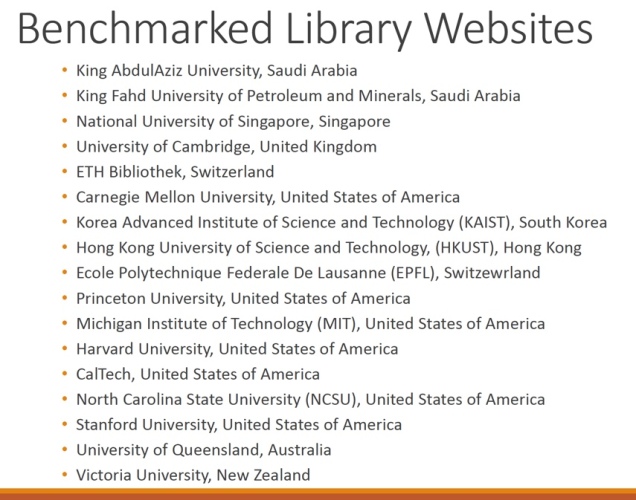
From my comparative study on benchmarked library websites (2015) which was conducted together with my colleague, the Senior Subject Specialist, we noted that the top 5 services deployed the library websites were:

  1. User Services: Checking how items that have been borrowed, reserved status and so forth.
  2. Reference/Research Services: Asking a librarian question, live chat services.
  3. ILL/Document Delivery Request.
  4. New materials recommendations
  5. Library alerts, News, and Events.

chat

Top 3 Social Media tools deployed:

  1. Facebook
  2. Twitter
  3. Youtube

Digressing a bit: Social media is another avenue apart from the library websites where our users can also do stuff that is available on library websites.  We have already had library alerts and news announced on Facebook and Twitter.  We have seen library videos on how to borrow books in the library and so forth.  LibAnswers (online reference services) can be activated in Facebook and Twitter as well.  Users do not need to visit library websites anymore to get information.   On top of that, I had listened to a talk by one of the library directors that mentioned the low rates of library website visitations.

  • Should we worry that library websites are no longer the main source to get information?
  • How much of an impact have those services had on our users?
  • How do we measure the success rate of each visitation? How do we define success?

These are just some of the questions swirling in my head …

Below is the list of benchmarked library web sites that we had used:

library

ListBenchmarkedLibs